

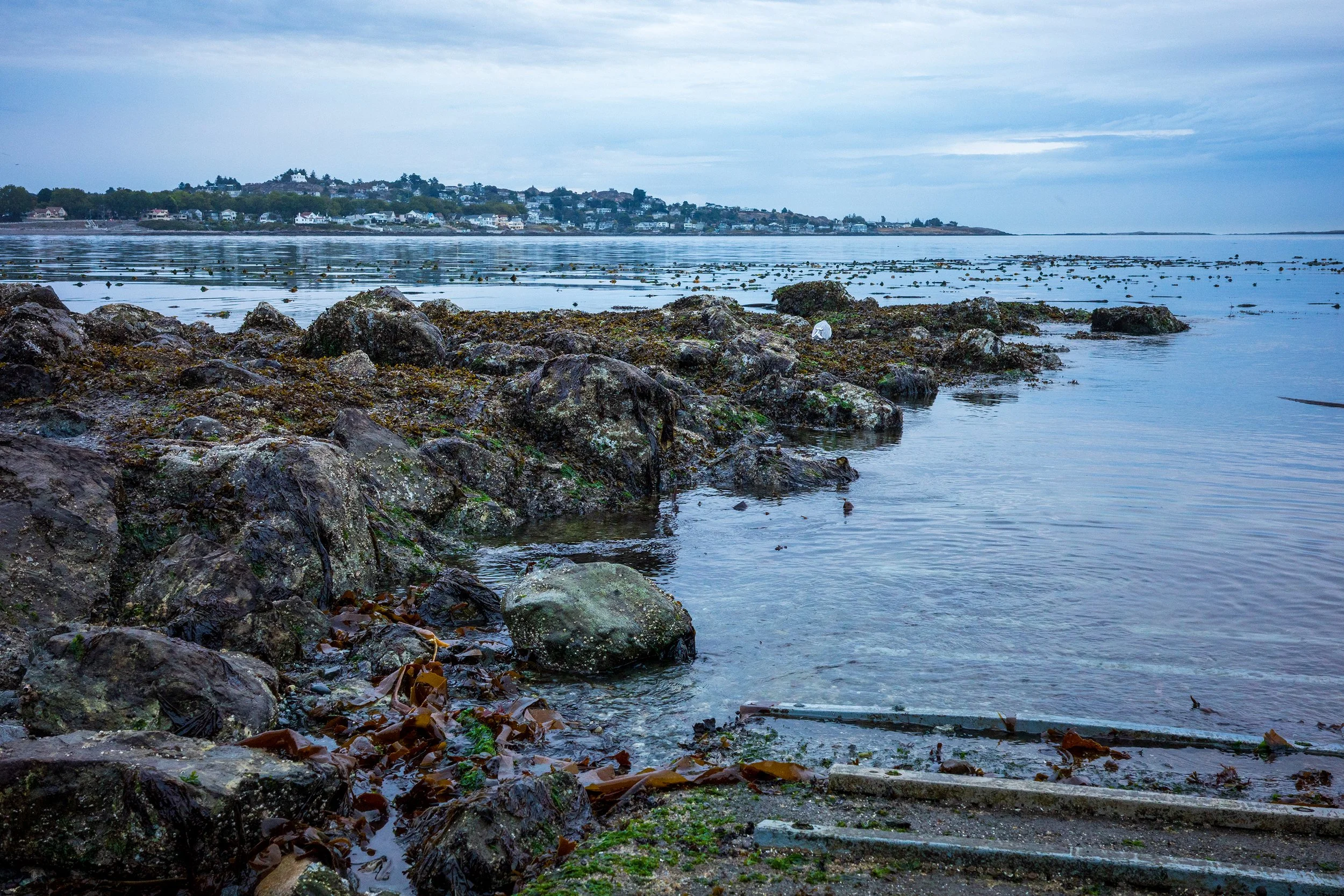
The boat ramp by Clover Point where Sean ends his runs, finding himself in good community with the water and rising sun.
“I have the benefit of good night vision,” Sean says, declining my offer of a head torch before we set off into the pre-dawn darkness.
Our run begins with a warm-up walk down a quiet, tree-lined street. The only sounds, besides our feet striking the pavement, are those of a still-sleeping city: clanking garbage trucks, the distant wail of emergency vehicles and, given our proximity to the ocean, seagulls.
This route has been Sean’s regular for about a year, ever since he moved from Chinatown, a kilometre away as the crow flies. Back then, his usual path followed a walkway along the waterfront opposite Victoria’s Inner Harbour.
“But this is much more aligned with who I am,” he says.
Our pace gradually picks up as we move through a neighbourhood that, apart from the occasional dog walker or driver pausing to let us cross the road, appears empty on this overcast, slightly cool Friday in early September.
Sean explains that because he was born with his legs turned inward, he was never too good at running — something he says I’ll soon witness firsthand.
“I kind of run like the albatross from The Rescuers,” he adds.
It wasn’t until his early thirties that his foray into physical fitness began, following a breakup and a resulting visit to the doctor, who prescribed a simple remedy: pound pavement.
Sean began ambitiously, with daily walks up the trails of Mount Tolmie, a local hill about 100 metres high near the University of Victoria.
He then made the leap to Mount Doug, nearby but twice as tall and offering a much more arduous ascent. Undeterred, he continued his routine there, eventually feeling compelled to jog up parts of it.
“So that’s how I came to be a runner. Weirdly.”
“We’re going to start,” Sean announces as he settles into a run. “I can’t guarantee how much I’ll be able to talk during this.”
We continue down the avenue towards a corner of Beacon Hill Park, where a lawn bowling green and cricket pitch come into view. Along the way — and without much trouble — Sean explains how he had previously lost touch with running after moving to Calgary.
With the city’s relative lack of natural spaces — not to mention its frigid winters — he found himself stuck training indoors. Then COVID hit, those facilities closed, and he soon stopped exercising completely.
Some time later, a teaching position took him back to Victoria, where a reunion with the outdoors and coastal landscape compelled him to pound the pavement again.
“It was very joyful when I found out I could actually run after years of kind of being told that I can’t,” he says.
As a climate journalism professor, Sean had long focused on the human consequences of climate change. Then a new friend, whose spiritual practice was deeply rooted in nature, got him thinking about how the natural world shows up in his own life.
The runs became opportunities to be in good community with his surroundings, especially the water and sea life. Watching the sun rise is also an integral part of his routine.
“That’s why I got us up at the ungodly hour of six o’clock,” he says.
A pair of rabbits dash across our path, crashing through a row of bushes along the cliff edge to our right, above a rocky beach.
Looking out over the ocean, Sean says his favourite time of year is nearing, when the migratory sea lions return and settle on the Trial Islands, their cacophony of barks carrying across several kilometres of ocean.
“It’ll be nice to have that company back,” he says.
Another community he encounters along this route is a small but regular group of “sunrisers,” people who converge on the waterfront at the crack of dawn to watch and welcome the first light of day.
“We’re about to hit that time of year where a run will let me be a part of that lovely gradient where you just see orange on the horizon,” Sean says.
The comings and goings that autumn brings — some birds fly away as others return to take their place — have always made it his favourite season.
“It’s just such a lively time,” he says. “At a time when everything is concurrently dying.”
His work with extreme weather events has made him aware of how devastating these moments of rupture can be. He believes we shouldn’t lose sight of that.
At the same time, Sean sees beauty amidst it all, even if calling those moments “beautiful” would be trite. It’s another reason why he loves being here in the fall:
“You’re directly in relationship with everything that’s going on.”
Gradually, the path slopes down as we pass a long, fenced-in field largely reserved for off-leash dogs. We then head around Clover Point, a tiny peninsula where, on windy days, people often fly kites or take in the mountain views from the comfort of their cars.
Sean next leads the way along a wide concrete walkway that butts up against a beach, waves sloshing on the shore mere metres away. This stretch, he says, was littered with storm debris when he ran along it yesterday. By now, what remains is mostly bits of seaweed and driftwood, thrown up by the ocean and left to settle.
“You become acutely aware of the changes and where and why things happen down here when you are constantly visiting a place like this,” he says.
Realising I hardly notice half of what Sean does on the many occasions I’ve run here myself, I ask whether he’s always been this observant.
His capacity for observation comes from several places. One is having been bullied through childhood and into his teens, which made him hyper-attuned to other people’s emotional weather as a way to assess risk. How likely was he to be picked on, hit, or teased?
“If we were to look at Dungeons & Dragons character stats, I do have a very high wisdom score,” he adds.
“We're getting a little bit of pink on the horizon,” Sean says, pointing towards the ocean as we pass the expanse of Ross Bay Cemetery on our left. A little farther on, we reach the turnaround point of his route, near a water fountain at the top of the bay.
“It must be around 6:35,” he observes.
“6:38,” I reply, checking my watch.
“I know what it looks like when the sun is just about to come up,” he adds. “It’s hiding from us right now — she’s shy sometimes.”
On mornings when the sun does make an appearance, Sean often stops to take photographs. One captured a group of young people taking tentative steps towards the ocean, gathering courage to immerse themselves fully in the frigid water.
“I loved the gradient of the sky,” he says. “It was so yellow with traces of orange, and the camera sensor just kind of picked up their silhouettes.”
We arrive at Sean’s favourite spot along the route, following a narrow dirt path towards an old boat shed. We gingerly make our way down the ramp, its surface getting slicker as we near the tideline.
On a clear morning, the sun aligns with this exact spot on the horizon. When it does, he looks towards it, reflecting on his life or what the day might bring.
It’s a moment of clarity.
He also appreciates the contrast here: living and dying are on full display. Barnacles cling to kelp-draped rocks while the wood of the well-used boat launch bulges, bows, and rots.
“It’s so much complexity. You just have to look for it.”
Just as our run began, we end with a stroll, this time to a café. The sound of cyclists carries through the stillness, their conversations growing louder until they whizz past and out of earshot, disappearing down the same road we’re heading towards.
“We will end up seeing them at Moka House,” Sean says confidently. “That’s where they go.”
A little farther on, as we come back along the off-leash area, he nods towards another regular: a man slowly pulling an empty cart through the field, followed by what looks like an elderly lab or retriever lumbering behind him.
“He carries his dog in that wagon,” Sean says. “And I say hello to him.”
As we near the crosswalk at Cook Street, Sean points ahead to a large spiral staircase. Made of cement, it descends from the path to a beach below. When he returned from Calgary to take up his current teaching position, he found himself drawn to that spot.
“I walked down those stairs, went to the water, put my hand in it and said, ‘I promise, I promise, I promise, I promise I’m going to do something about this.’”
At the time, Sean’s focus was still firmly placed on the human toll of climate change. It took looking back at those early climbs to realise his connection to nature had been there all along.
“Why did I hike up Mount Tolmie? Why did I hike up Mount Doug?” he asks, replaying that moment. “It was so I could see the sun and the water.”