

The Rainbow: Part Two
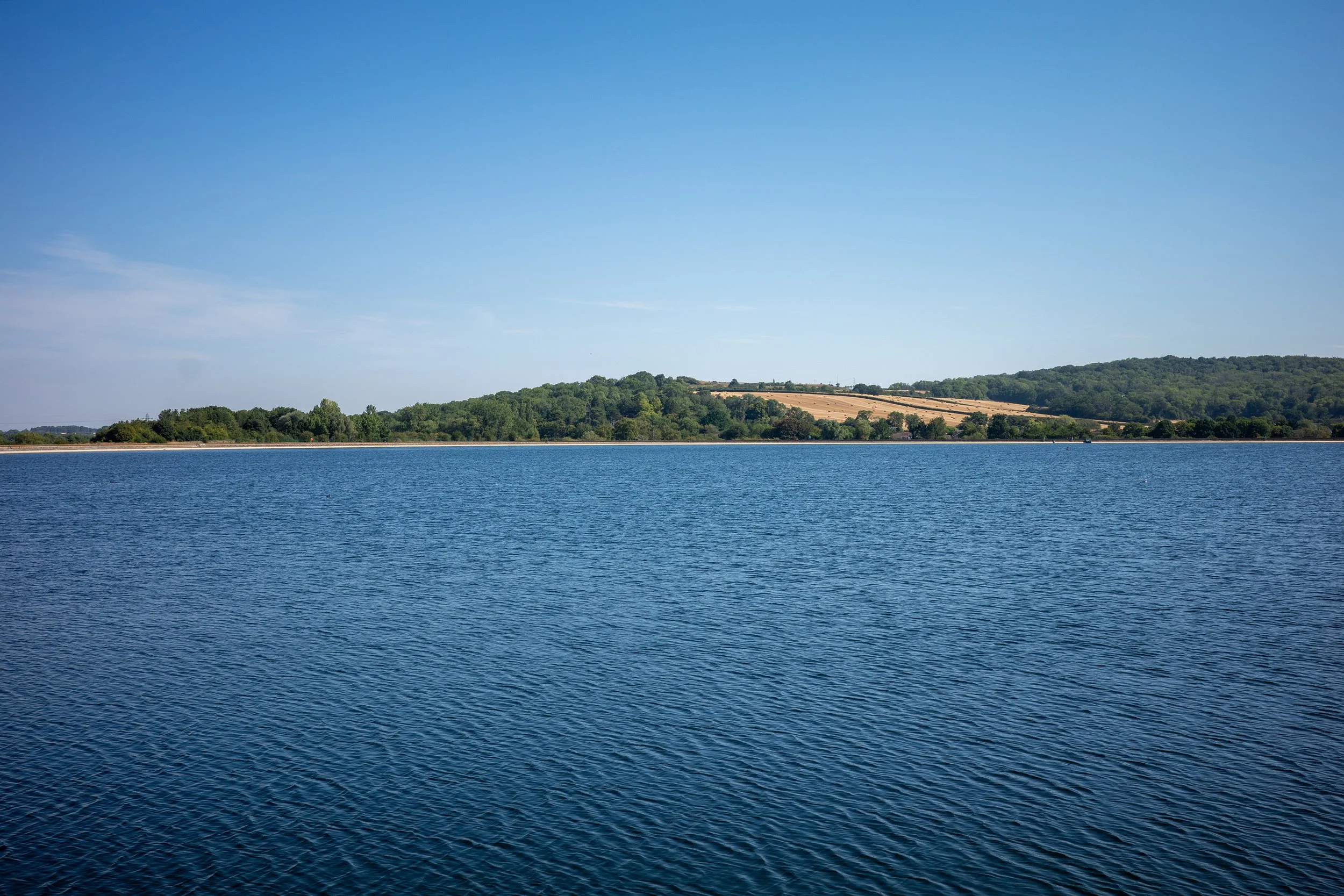
View from the Farmoor Reservoir causeway, where Nick runs year-round while pretending he’s James Bond.
“What area is this?” I ask as the grass gives way to a paved lot.
“Northmoor,” Nick says, pointing to a sign reading Northmoor just a few steps ahead.
We pass The Ferryman, a custard-coloured pub overlooking the Thames, beside an ancient crossing where a chain ferry once carried passengers between Bablock Hythe and the hamlet of Eaton on the opposite bank.
After many kilometres of running through farmland, it feels odd to have tarmac underfoot. Nick explains that this is merely a detour, a way around the patch of private land ahead.
“We’ve got some sheep,” I offer as we continue down the quiet road, a small flock gathered in a pasture to our left.
A latched gate on our right returns us to the path. We continue along the edge of another field, the air noticeably warmer now that the river — and its gentle breeze — lies half a kilometre east.
“Watch out for all the poos,” Nick warns as we enter the next pasture. There’s not a single sheep in sight. But I soon notice some napping on the other side of the fence, seeking solace in the shade beneath a row of trees.
The next flock we encounter is on its feet, grazing by a gate, several scattering as it swings open. Some of the more adventurous lambs come crashing through the reeds, one emerging with a long stem clenched between its teeth.
“Funny things,” Nick says.
“Have you ever been chased by them?” I ask.
With a slightly nervous laugh, he recounts a time when he was running through a nearby field at night. Assuming it was empty, he was surprised when his head torch illuminated a cow standing directly in his path.
It wasn’t alone.
Nick spun around to realise he’d been encircled by cattle.
“They started to get a bit feisty, so I took out my phone just to record my last moments.”
He eventually found his way to a fence, located a stile, and climbed over unscathed.
For me, the possibility of a bovine battering would always be at the back of my mind on every future run.
But not Nick.
“I mostly just think about running when I’m running,” he says. “It’s nothing too profound.”
His thoughts may not, by his own admission, be particularly philosophical. His mindset, however, is shaped by something deeper:
“My dad had a stroke when he was 55 and was seriously disabled after that. So I hate to complain when I’m running, because I’ve got the option.”
We continue along the path, cutting diagonally across a pasture where the grass is parched white and covered in scrub. It looks more like a savannah than an Oxfordshire field.
“Yeah,” Nick says. “They’re struggling with the heat at the moment.”
Perhaps the heat is also keeping the birdsong at bay. Despite the never-ending hedgerows — where I imagine warblers, robins, and wrens love to live — I haven’t heard a single chirp all morning. There is, however, no shortage of waterfowl, including a gaggle of greylags pecking near the path.
“The geese are a lot more aggressive than the sheep,” Nick says. “They have a real attitude.”
We leave the pasture and cross a narrow bridge above a weir. With the Thames now surrounding us on all sides, we’re essentially on an island — albeit quite a small one — as we run through a pint-sized forest.
Emerging from the trees, we arrive at Pinkhill Lock, its stone cottage and landscaped lawn looking almost identical to the one we passed earlier. Not wanting to sound rude, I keep this observation to myself.
“You can see, it’s almost identical to the other,” Nick says. “They’re like a standard format along the Thames: lock house, nice garden.”
Here, though, what looks like a sea-green shag carpet covers the water around us. “You probably wouldn’t go swimming in that bit,” he says, pointing to the weeds.
Nick pauses atop the lock gate to explain how it works. “You twiddle these handles,” he says, standing before a large black wheel like the kind you’d find on a pirate ship. The rest of the process — pushing levers, evening out water levels — is far beyond me.
“It’s pretty easy,” he says. “We used to get the kids to help do it.”
Lesson over, we leave the lock. A dirt road leads us to a grassy bank, which we climb to a concrete footpath.
“Oh wow!” I say, looking out at Farmoor Reservoir and its wide expanse of navy-blue water.
“Suitable reaction,” Nick says.
We continue running anti-clockwise around the perimeter, the cool air a welcome treat. Several swans are asleep along the water’s edge, their heads tucked back and resting on their backs, while a couple of cormorants stand in the sun, wings spread wide.
About halfway around, we turn onto a causeway stretching a kilometre across the reservoir. Nick says he likes to pretend he’s James Bond here, sprinting along the dam in that scene from GoldenEye.
“But kind of in slow motion,” he admits.
Continuing along, Nick points left towards a sloping pasture in the distance, where hay bales currently hog the field. Over the seasons, he’ll observe from afar as combine harvesters gather the next crop.
“I just love watching the change throughout the year,” he says.
“Is there fishing?” I ask, entranced once more by the shimmering surface.
“Yep. There’s one Strava segment called Dodging the Fly Fishers.”
Coming to the end of the causeway, we pass a camp of kids on the shore, wearing life vests and safety helmets while listening to instructions. Nearby, a fleet of idle sailing dinghies bobs on the water.
“So there’s the café if you did want anything,” Nick says as we near a building overlooking the reservoir.
“I think I’m okay.”
With that, we cross the car park, pass the public toilets, follow a narrow gravel path through some trees, and head down a residential road before slipping back into the countryside.
“Are you allowed to run on the field?” I ask, only then noticing I’ve ventured off the path.
“This is fine because there’s nothing growing. But when there are crops, you’d avoid it.”
“Feel free to have a crack up to the bench,” Nick says as we near the base of the hill. “I’m not going to.”
“I’ll stick with you,” I say, realising that by “have a crack” he means “sprint.”
The path continues to climb, getting steeper as we go. If this were a paved road, per se, the gradient would be manageable. But it isn’t. The rough terrain, dotted with divots, steals my momentum, zapping me of energy every time my foot falters.
“That little clump of trees you see, that’s the top,” Nick says, leaving me to wonder whether it only looks “little” because it’s very far away.
At last, we reach the summit, breathing hard but at least not bent over double. We pass through a couple more fields before reaching a country lane of hard-packed dirt and gravel, which we take.
Further along, a field of maize stretches to our left. It reminds Nick of past ultramarathons, and of how, while racing, he would compare the landscapes around him with sections of this route.
“I did this night race, and I was running through cornfields,” he says. “I was like, ‘It’s just like the cornfields in Cumnor.’”
“Oxford is left. Appleton is to the right,” Nick says.
We arrive at what feels like the first main road all morning. As it bends around the outskirts of the village, we pass a Saxon-era stone church, its slender stained-glass window facing rows of old headstones in the graveyard below.
“That’s a neat clock,” I say, noticing the diamond-shaped timepiece, with its azure-coloured dial and gold numbers, set halfway up the turreted bell tower.
The road bends again. Rather than follow it further, we head straight down a country lane, which eventually leads to a stretch of singletrack wedged between fields.
“You definitely notice the heat more here,” I say, the Thames now two kilometres to our right.
A brief reprieve from the sun arrives as we follow a narrow dirt trail through a copse. “Watch your head,” Nick says as we slow to a crawl, squeezing between foliage and ducking beneath branches.
As cumbersome as it is to claw our way through, we’re lucky to have the chance. Depending on the season, the path becomes either too muddy or too overgrown, making it impassable for much of the year.
“So in the peak of summer, you can’t do it. And in the peak of winter, you can’t do it,” he says.
At last, we reach the route’s penultimate pasture. Without warning, the ground turns soupy, leaving us up to our ankles in stagnant water.
“Sorry,” Nick says. “I didn’t know that was boggy.”
“That’s alright. It’ll make for good audio.”
We emerge from the path beside an old stone house in the village of Besselsleigh, a mile west of where our run began — and where it will end in a few minutes’ time.
Upon reaching the front of the property, we pause beside a well-groomed hedge.
“You see these little signs?” Nick asks, pointing to a trail marker partially hidden by leaves, its yellow arrow indicating the way we just came.
As it happens, this very placard prompted his exploratory runs when he first moved to Appleton. Seeing it again seems to have sparked that initial thrill of discovery — something a pre-planned route can’t offer.
“It’s just a case of keeping your eyes open, spotting a sign like that and thinking, ‘Oh, I wonder where that goes?’”