

The Rainbow: Part One
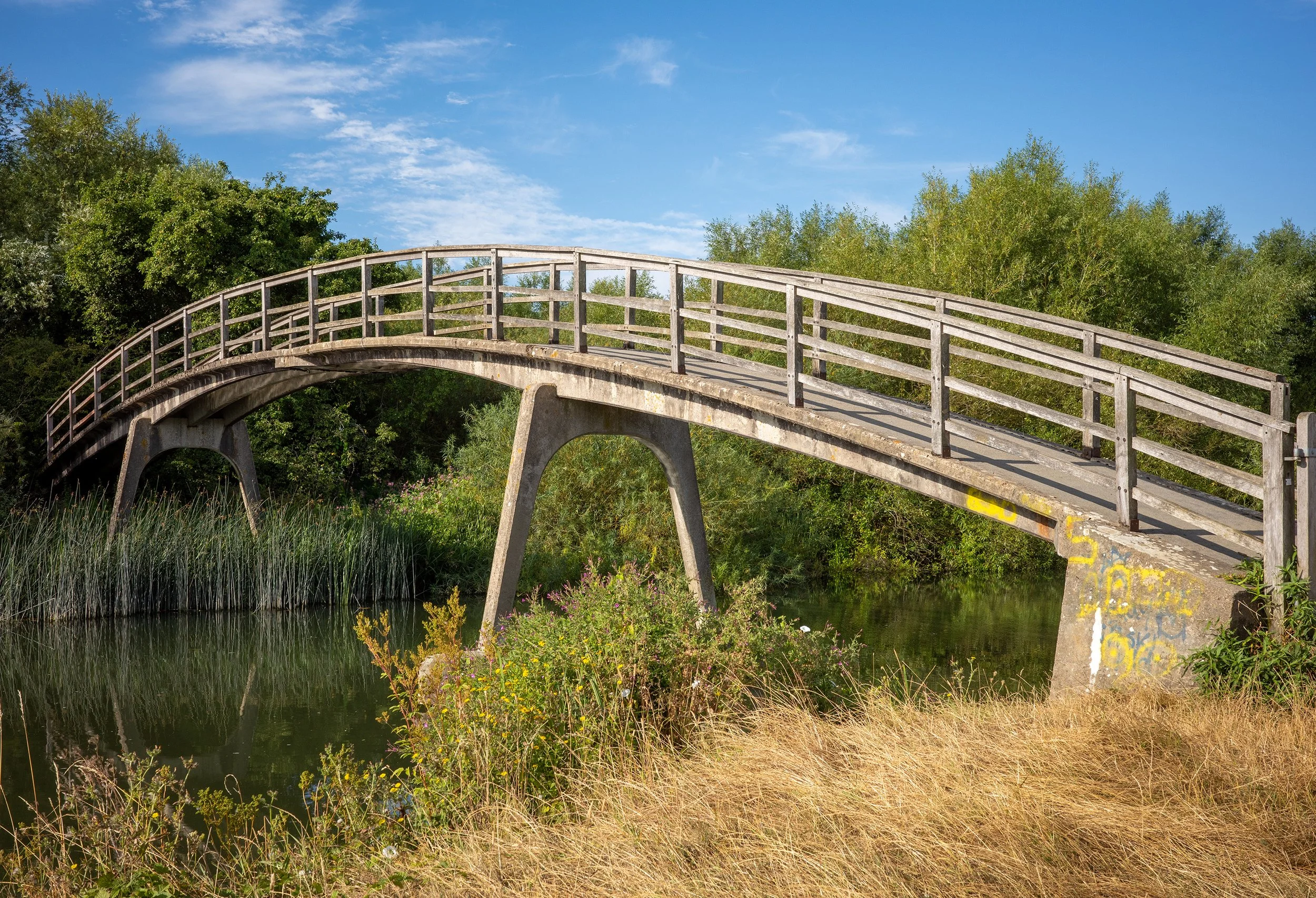
The aptly named Rainbow Bridge spans the River Thames, marking one of Nick’s favourite points along his twenty-odd-kilometre route.
“What I love about running is you can start from your front door,” Nick says as we head down a road away from his house. As it happens, he discovered this route — and the front door it begins from — while on two wheels. His former cycling club’s rides, on their way back into Oxford, often passed through the village where he now lives.
“So when it popped up on Rightmove it was like, ‘I know Appleton,’” he says.
That was over a decade ago.
With a web of trails right on his doorstep, he spent years exploring, stitching paths together into what eventually became his signature route: a course stretching tens of kilometres through the countryside.
“Now, of course, we’ve got Strava,” he says. “So it’s much easier to find routes like this.”
I ask whether, had GPS apps been around back then, he still would have explored to find new routes or simply mapped one out online.
“I can say with certainty I’d have plotted it in advance,” he says.
Leaving the village behind, we head along a lane flanked by fields before entering a patch of woodland. Nick leads the way down a narrow dirt path, foliage encroaching from both sides. With little room to manoeuvre, we run single file, Nick surefooted as I stumble after him.
“How’s this in winter?” I ask, looking down at the ground, its cracked surface hinting at how mucky it gets.
“All these bits will be completely boggy,” he says. “So it sort of closes down as a route.”
Today, though, it seems made for summer. Recent dry weather has rendered the once-muddy trail manageable, while the canopy overhead offers welcome shade before we head back into the sun.
“We should probably go that way,” Nick says, taking the right-hand fork.
We emerge from the woods and cross an open pasture, where an electricity pylon rises from the grass. He asks whether I’ve seen The Castle. I haven’t. The cult Australian comedy follows a family who, despite their modest circumstances, maintain a positive outlook. Rather than seeing the transmission towers outside their home as eyesores, the father regards them as “a reminder of man’s ability to generate electricity.”
“I always think of that when I see them,” Nick says.
A short stretch through another clump of trees brings us to the base of a concrete footbridge spanning the River Thames. It’s called Rainbow Bridge, and it’s not hard to see why. Arching from the foliage as though suspended in a cloud, it reaches the opposite bank, where the summer sun has burnished the grass golden.
“We’re on the Thames Path now,” Nick says. “So that goes all the way to London.”
The pasture we’re in is pretty much bare, save for a lone white bird that looks like a seagull but is in fact an egret. Nick says this field, like those nearby, changes with the seasons — soil is ploughed, seeds are sown, and crops are eventually gathered.
“Is there livestock on them as well?” I ask.
“They often graze,” Nick says. “There might be cows on the route,” he adds, his tone almost cautionary, though I’m not sure why.
We keep running.
The portion of the Thames Path Nick and I are on is a strip of worn grass. For me, it’s something of a novelty. The stretch I run in Oxford is paved and shared with cyclists, while back home in Canada, farmland is typically off limits because, unlike here, we don’t have public rights of way.
We move wide, making room for a pair of walkers. The path is quite narrow, but Nick says it becomes narrower still when the farmer erects an electric fence to keep his livestock out of the river.
To our right, the Thames flows quietly beneath the morning sun. On the opposite bank, a pair of wooden boat sheds sit at the water’s edge, with the houses they serve tucked well back from the shore.
“You just drive your boat into your garage,” Nick says. “I think that’s really cool.”
Three hikers emerge through a latched gate as we approach the end of the pasture. Each carries a large rucksack, and one leads a dog on a leash. The field has recently been cut, leaving stiff stalks poking from the soil like the bristles of a giant brush. Instantly, the dog flops down and refuses to move, everyone laughing as the owner drags it across the stubble.
“That must feel good on the fur,” I say.
Further along, in another field, Nick explains that this particular stretch of path isn’t doable year-round. The area sits on a floodplain, and come winter, the rising Thames can render it impassable for months.
“Do you make a detour?” I ask. “Or do you find a way through it regardless?”
“I've been through when it's been up to my knees,” he says.
While others might head for dry land, Nick, an avid ultrarunner, embraces the flooding as an opportunity to train for future races.
“A good thing about the changing conditions is it does prepare you for a variety of things you might encounter,” he says.
The conversation turns to spring, Nick’s favourite season. (It seems a shame to dwell on wet winter weather on a morning like this.) For him, it begins with the first “pops of colour” as wildflowers appear along the route.
But the runner in him then takes hold.
“The biggest thing is when the trails start to dry out,” he adds. “Suddenly, you notice you’re coming home and you’re not caked in mud.”
“Have you stepped in many of these?” I ask, narrowly missing a landmine-sized cowpat in the middle of the path.
“No,” Nick says. “You get pretty adept at dodging them.”
We’re heading through what I think is our fourth farm field, nearing the quarter mark of our journey. Two runners in racing singlets offer a brief greeting as they whiz past. Nick says he was once a dedicated road runner, spending many miles pounding the pavement before switching to trails to spare his joints.
“Watch your ankles,” he says as we reach a particularly lumpy stretch.
Glancing down to check my footing, I notice prickly plants lining the trail’s edge. Some are nettles, others thistles, Nick says, though he doesn’t bother avoiding them because doing so spoils his flow.
“Are the thistles the ones with the purple top?” I ask.
“Yeah. They don’t sting,” he says reassuringly. “They just got spikes.”
We pass through a wooden gate onto a concrete path that runs alongside a patch of grass so well maintained it could serve as a bowling green. With sweeping views of the Thames and plenty of room to lay out a blanket, it seems the perfect picnic spot.
“Do people swim here?” I ask.
“Not exactly,” Nick says. “Because of the lock, it’s really dangerous.”
We leave Northmoor Lock through the opposite gate and rejoin the grassy path, with more pastures stretching to our left and the Thames winding to our right.
“I can't believe the trees along the riverbank,” I say, the foliage so lofty and lush that a grand estate could be hidden behind it.
“You can see why I keep coming back,” Nick says. “There’s just something about the water.”
On that note, hydration flask in hand, he asks whether I have anything to drink myself. I explain there are two small bottles of water in my pack, though they’re reserved for my interviewees. I’d felt it was only fair that they have something to sip after enduring all my questions. Now, as sweat pours off me, my complimentary refreshments look rather tempting.
“There’s a cafe on this route if you need anything,” Nick says. “And toilets.”
Having lived in a city my whole life, where a fast-growing population has steadily pushed into rural areas, I can’t help wondering why this open land remains so empty. The surrounding landscape, Nick explains, is part of a green belt, a protected band around Oxford where development is restricted to prevent urban sprawl.
“But all this is actually a floodplain,” he reminds me. “So they wouldn’t want to build here anyway.”
As we near a bend in the river, Nick points out a squat, square concrete structure on the bank, half-hidden by shrubs. It’s an old World War II bunker, built to defend against German boats should they have made it up the Thames from London.
Nearby, I notice some chestnut-coloured cows grazing on a grass-covered mound, its top rising nearly as high as a four-storey house. To me, it looks steep, so I ask whether this counts as a hill around here.
“I don’t know,” Nick says. “They’re pretty small for hills.”
He then shares an anecdote about a proper hill farther along the route that he and a friend often run together. One day, feeling strong, he decided to push the pace and race his friend to the top. Nick won and was rather pleased with himself.
The satisfaction, however, was short-lived.
“The next day he went to the doctor and discovered he had diabetes,” Nick says. “So then I started feeling bad.”