

The Reaper
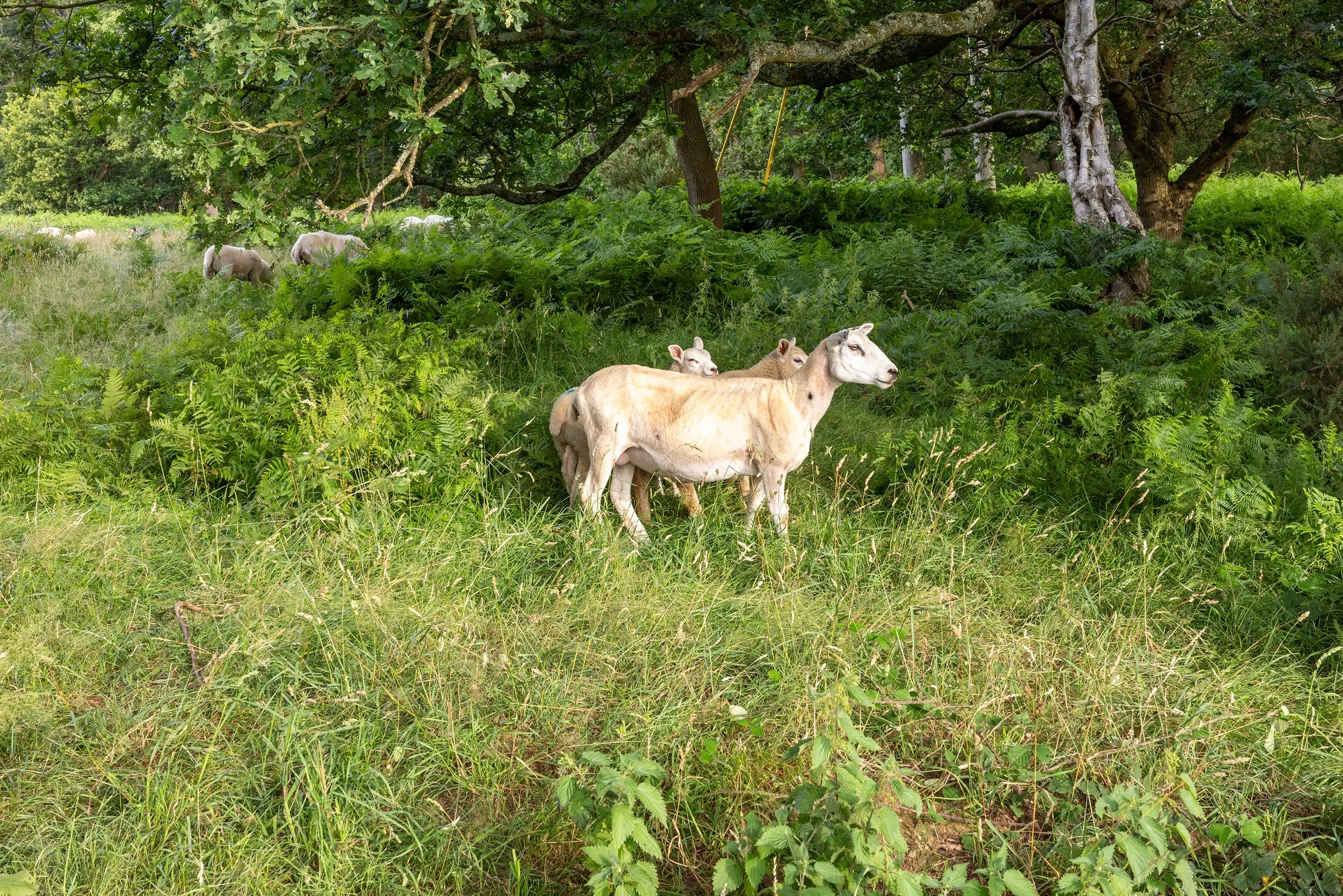
Goats graze in the field above where the “Grim Reaper” once stood.
“So yesterday, there was someone coming down here with a Dobermann,” Marie says, pointing to a path. Only a few minutes into our run, we’ve already gone from her front door to the forest — a perk of living so close to the countryside.
“There’s one in the area that’s got a bad rep,” she continues. Unsure whether this was the notorious dog, and seeing that it was off-leash, she decided not to take any chances.
“So I came through here,” she says. “Do you want to try it?”
“Sure.”
We leave the trail and detour into the woods. The trees have been planted in dead-straight lines, giving the impression of a quiet lane lined with perfectly spaced lamp posts.
“It’s as if someone went, ‘Ah, we need some trees,’ and came up and planted loads of them,” Marie says.
A muntjac deer bounds through the foliage further ahead. The only trace of human life here is a lean-to: a tarp hung between two trunks.
“That was creepy last night,” she says, nodding towards the makeshift camp. “I was like, ‘Is somebody hiding out in the woods?’”
We reach the edge of the forest and follow a narrow footpath. Dense bushes on the left mark the boundary of the adjacent farm field. “Oh, sugar!” Marie says, caught out by one of Mother Nature’s booby traps — perhaps a nettle, a blackberry bramble, or a divot in the dirt.
She mentions a 10-kilometre race that passes nearby. Having run it herself, she was already semi-acquainted with the landscape before moving here. Getting a lay of the land, however, still took time and patience.
“I just kept coming out, spotting a new route and giving it a go,” she says.
A small pedestrian gate opens with the squeak of weathered hinges. Beyond it lies a wide expanse of pasture dotted with sheep. Some are entirely white — or as close to white as farm sheep get — while others have jet-black faces.
“So these are this year’s lambs,” she says, pointing to the smaller ones. “But they’re getting kind of chunky now.”
The sheep bleat in apparent objection as we thread our way through the flock, lifting their heads from the grass before shuffling aside.
“Sorry,” Marie says as one hurries off.
We continue towards another stretch of woodland. The field is deceptively steep, enough to raise your heart rate if you don’t ease the pace. Around halfway across, Marie points out a large metal basket perched atop a tall pole, surrounded by shrubs.
“We call that ‘The Beacon,’” she says.
Although she’s never seen it used herself, Marie recalls it being lit at some point, possibly as part of a local celebration.
“I can’t remember the occasion,” she admits.
At the end of the field, another latched gate opens onto a quiet lane, empty on this late-May morning. Beside the entrance is a patio chair beneath a tree. Marie tells me that an elderly woman sometimes sits there, though she doesn’t know why.
“There was a lady walking down here yesterday,” she says, gesturing further up the road. “I wondered if it was her that sits on the chair. But I thought it’d be rude to run up and quiz her, so I didn’t.”
We turn left before the woodland and run along the edge of the road. Marie explains that the area to our right, known as The Hurst, was bought by local communities to preserve public access. As part of forest management, cattle graze amongst the trees.
“It’s a bit unnerving because you don’t know when you’re going to run into a cow,” she says. “They’re just sort of lurking in the woodland.”
I have no idea where we are, having lost my bearings around the time Marie’s street gave way to the trail — so about a minute into our run.
Marie tells me she’s terrible at navigating too, though I’m not convinced. At the end of almost every path, road or field, she points towards another route she’s previously explored, or an extra loop she’ll occasionally tack on.
“It’s taken me a long time to build up this map in my mind and make decisions on the fly,” she says.
Marie points towards a parallel path where a lone walker is making their way along — yet another route she has tucked in her back pocket. But it’s so overgrown now that, the last time she ran there, she was stung by countless nettles. She recalls someone suggesting that ultrarunners deliberately sting their legs with nettles to increase blood flow.
“If I run into them, fine,” Marie says. “But I’m not gonna do it on purpose.”
We leave the lane, pass through another farm gate, and cut diagonally across a field back into a different patch of woods. A paved forest road appears, lined with the occasional lavish estate, each house set well apart behind trees, giving the area an air of exclusivity.
“We’re gonna go left here past this little post box,” Marie says, leaving the road for a dirt path that runs alongside a house. She points to a section of high stone wall where fresh mortar fills the gaps. A while back, the top had been taken down and rebuilt.
“Suddenly, I could see more than normal,” she says.
But once the repairs were finished, her view vanished again.
The path drops steeply, levels out for a few strides, and then climbs just as sharply. In dry weather like this, the footing is manageable. During the rainy months, though, water runs down both slopes and pools at the bottom, creating a mud pit. As if worried she’s undersold the place, Marie adds:
“Earlier in the year you get quite a few bluebells, so it’s quite nice.”
We’re back in the open, following a row of bushy trees that divide two farm fields. Before long, we come upon a rustic farm fence. Beyond it sits a weathered wooden seat.
“You see this bench?” Marie asks.
Beside it stands a large solitary oak, believed to be around 200 years old. Next to it, a noticeboard identifies the spires that rise above Oxford’s skyline. On mornings like this, with a low haze hanging over the city, even the tallest church tower is difficult to discern.
“You’ve got some cranes,” I offer.
“Yeah,” Marie says. “There’s always cranes.”
She discovered this spot on one of her first runs shortly after moving here. She’d seen a sign with an arrow pointing this way and wondered where it led. At the time, she was going through a particularly difficult period in her life, and found solace here.
“That sticks with me,” she says. “Just that moment of reflection, sitting there in peace and looking out.”
We continue across the pasture, following a rugged footpath. There’s no livestock here today, but plenty of signs they were here recently: patty-shaped and pellet-sized droppings, and scraps of wool snagged on the thistles. Marie says cows are often kept in this field, and over the seasons she’s come to recognise the same pair of bulls the farmer brings in each year.
“There’s one that’s quite quiet, and then a bigger one that just follows the girls around,” she says.
Our feet follow the slope back towards the lane. In dry conditions, it’s the kind of long, steady descent that offers a welcome reprieve from the earlier climbs, letting you simply coast and take in the views. But when the weather turns wet, Marie warns, it becomes treacherous.
“It’s just like a waterslide,” she says.
At the bottom lies a pile of dried, insect-ravaged tree parts — trunk, limbs, roots heaped together.
“So this is quite funny,” Marie says as we approach it.
Before it rotted away and was trampled by the lambs that now use it as a playground, one dark section of the tree stood upright. It looked like a black-cloaked figure.
“So I’d run down here and say hi to the Grim Reaper,” she says.
We pass through a pedestrian gate at the bottom and emerge back onto a lane. We run past another field, smaller than the last and recently mown. Parallel rows of cut grass stretch from one side to the other, drying in the sun, while groups of birds — magpies and, I think, starlings — pick through whatever the tractor has left behind.
It reminds Marie of her childhood.
“When we were kids, we used to play with the grass and build little dens, which I’m sure the farmer wasn’t too happy about,” she says. “We were very young, so it wasn’t a very good den.”
Further along, the lane becomes enclosed by dense foliage, trapping the warmth and making the near-perfect early summer morning feel slightly less comfortable.
“At lunchtime, this bit’s quite a drag,” Marie says.
She remembers walking this same stretch of lane during the previous week’s thunderstorm. Despite her affinity for wild weather, even she jumped when the lightning came too close. Further up the hill, she watched it fork in three directions across the skyline.
“That was pretty cool,” she says.
We approach the home stretch, the part of the route where Marie feels most like herself. The first couple of kilometres can be “a chore” as she slogs up the field full of sheep and past the beacon. At that point she’s in her own head, thinking about whatever’s stressing her and everything she has to get done.
“By the time I get in the woods, I’m like, ‘Oh, something’s changed here. Oh, there’s an animal.’ So it sort of switches up my mindset,” she says.
During her descent of the final slope through the field once haunted by the “Grim Reaper,” the distracting thoughts have vanished.
“I’m not really thinking about the same things then,” she says. “I’m in my happy place.”