

The Handicap
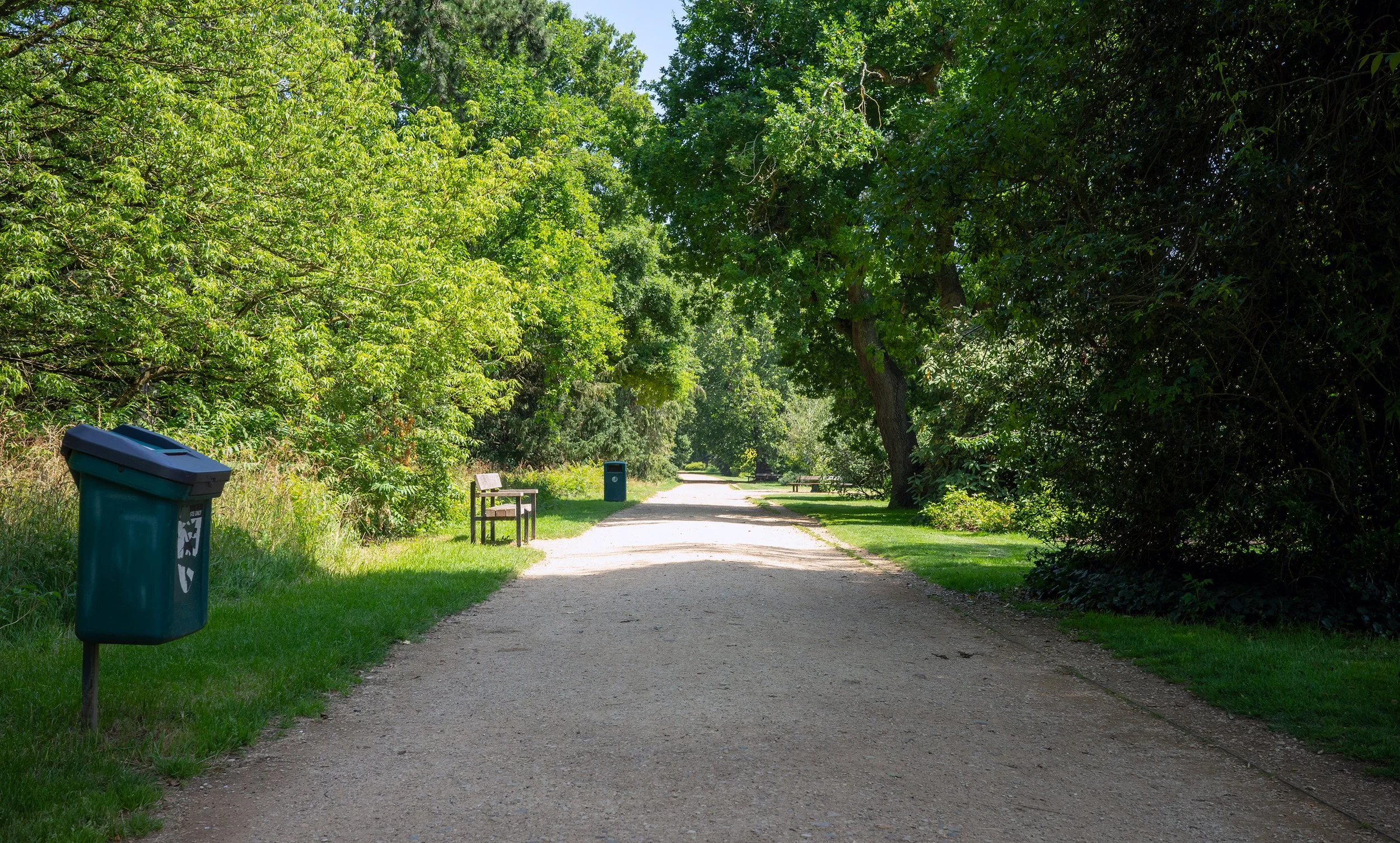
The approximate halfway point of Paul's weekly route through University Parks.
Paul is precisely where he said he’d be, beside a noticeboard at the bottom left corner of University Parks. He isn’t alone. Dickie is there too. The pair is part of a running group that meets at noon every Wednesday. It’s called a handicap: the slowest runner sets off first, followed by those who are faster, with the aim of everyone completing the 3.67-kilometre course at roughly the same time.
“You’ve got someone to chase,” Paul explains. “Apart from the poor sod who goes off first.”
Today, though, it’s just the two of them. The low turnout is likely due to the heat, already intense by noon. The previous day had matched Oxford’s June temperature record, last set in 1976. In response, Paul had emailed the group with a compromise: halve the usual number of laps.
“If you want to do one, that’s no problem,” he recalls writing.
But even that offer wasn’t enough.
“The only replies I got were, ‘Nah.’”
With no one else on their way, we set off, Dickie hanging back while Paul and I fall into conversation.
We head down a tree-lined path towards the Cherwell River. It feels like the start of a road race, with scores of people peppering the course. But rather than well-wishers, everyone we pass is silent, lazing in the shade — some with hats over their faces, others in little clothing — paying us no mind.
Staying cool, clearly, is priority number one.
Even the birds seem subdued. Their calls drift through the trees as we walk, against the backdrop of distant traffic and the crunch of fine dirt and gravel beneath our feet.
“I can remember when I used to think, ‘It's only about five or 10 years or something,’” Paul says when asked how long he’s been running the route. He then recalls an anecdote from two decades earlier that provides a more reliable marker. To celebrate his 50th birthday, one of the other runners handed him a bottle of bubbly before the start.
“You were running with the champagne?” I ask.
“Well, I couldn’t really leave it,” he says, laughing.
The handicap itself is much older, dating back nearly half a century, when the course wound through Christchurch Meadow, about a mile south of here. The previous location had been chosen for its proximity to where many of the members worked, but the narrow paths made overtaking tourists and other pedestrians difficult, so they began looking elsewhere.
A gentleman named John, whom Paul describes as one of the club’s “main leading lights,” took a measuring wheel to University Parks. By the time he had mapped out a route following the existing paths, he discovered it differed from the original course by only a few metres.
“So we’ve got the same distance course and a lot more ability to get out of the way,” Paul says.
You wouldn’t know it from the sparse crowds on this particular day, but Paul assures me the route is usually much livelier. Even so, the three of us could have walked side by side and still left plenty of room for others — dog walkers, joggers, people pushing prams — to pass.
Besides the regular park-goers, whom he greets with a nod or a hello, Paul says it’s not uncommon, being Oxford, to spot the occasional celebrity.
“You know Thom Yorke?” he asks.
The name is familiar, but I can’t quite place him.
“They’re an Oxford group,” he says, trying to recall their name himself. “OK Computer,” he adds, offering another clue.
“Supertramp?” I guess.
“Radiohead,” Dickie calls out from a few yards behind us.
“That’s what it is!” Paul says.
Thom Yorke, he tells me, used to pass them regularly while running along the footpath, although not for some time now.
“Apparently, he’s been ill, I think,” he adds.
For someone who’s been running this route for more than two decades, Paul says remarkably little has changed. Apart from the occasional new planting, the park remains much as he remembers it. The trees, in particular, are unlikely to go anywhere: the University Park’s website lists every species and exactly where each one is planted.
“So they’re not gonna move around too much,” he says.
Our conversation shifts to cricket, prompted by a group of players batting and bowling on a pitch in the middle of the park. Dressed entirely in white — floppy sun hats included — they’re about the only people willingly standing in the direct sunlight. Dickie wanders off the path for a closer look at the scoreboard while Paul recalls seeing former English international Kevin Pietersen play here during a pre-season match years ago.
“I sort of watched them hammering the ball around for a bit,” he says.
From there, the discussion drifts toward the hydration breaks introduced at this year’s FIFA World Cup. Paul says that if he had to take a side, it would probably be that of the fans, particularly those who boo when players are sent off for a drinks break — especially when the match is being played in a temperature-controlled stadium.
“I mean, you don’t need three minutes to drink a bottle of water, do you?” he says.
Almost as if the football gods had been listening, we come upon something mown into the grass. It appears to spell out a word, each letter roughly the length of a small bus. After several moments spent trying to decipher the message, we realise it reads: “World Cup.”
“They’re starved for creative stuff for the rest of it,” Paul says. “So why not do a bit of creative mowing instead?”
Before long, we’re back where we started. One lap down. One more to go.
Near what they consider the finish line is an automatic bollard that can be lowered to allow authorised vehicles into the park. Paul has a cautionary tale about it. He recalls a time when he was running alongside another club member, deep in conversation, when it suddenly beeped and began rising from the ground. His toe caught the lip, sending him forward.
“I’m about the only person who’s fallen over it,” Paul says. “So that’s something to look out for.”
Once again, we pass the scattering of people stretched out beneath the trees. Many seem hardly to have moved in the twenty-odd minutes since we last came by, save for inching further into the shade as the sun slowly shifts overhead. If anything, the only noticeable change is the temperature, now nudging thirty degrees.
Paying the heat no mind, Paul points towards a spot in the distance, one I can’t quite make out. “This is the place where I’d check my watch to see how badly I’m doing,” he says as we arrive. If he reaches the location — around a quarter of a mile from the start — in three minutes and twenty seconds, he knows he’s on track.
“But it tends to be 3:30,” he admits.
The other main milestone lies further along, on the opposite side of the park, where the sounds of nature are gradually overtaken by traffic from a busy road. As this isn’t an official race course with distance markers at regular intervals, they use physical landmarks as references instead. The halfway point, for instance, is a particular bush, which they somehow manage to distinguish from the rest. “And then, just between the next two benches, that’s where my kilometre thing kicks in,” Paul says.
It gradually becomes clear that Paul’s fixation with time has less to do with beating the competition than resisting the physiological effects of aging. He no longer dreams — if he ever did — of winning. Instead, he simply longs to feel like he’s running again, light on his feet, rather than merely trying to walk fast.
“I mean, it sort of tends to vary your goals as you get slower,” he says. He then adds that his quickest recent parkrun was nearly twice as fast as our current pace.
“So I can be faster.”
We continue along the route, turning left just before the river and passing a row of grass tennis courts, utterly exposed to the elements and, unsurprisingly, deserted. A park maintenance vehicle rumbles by, its wheels kicking up dust that hangs motionless in the still air.
Further on, outside the maintenance shed, a bright red water bowser sits hitched to the back of a truck, its equally vivid yellow hose coiled alongside. It’s clearly earning its keep. Apart from a few scorched patches, the surrounding foliage remains remarkably lush.
The park’s continuous upkeep means its paths remain accessible year-round. As we walk, Paul points out patches that have recently been resurfaced. To the casual visitor, they’re almost imperceptible, but to someone who has spent decades running here, the smoother surface means fewer dips to collect rainwater. If that still isn’t to your liking, there’s always another option.
“If you want, you can go on the grass,” he says.
Paul’s watch beeps.
We’ve passed the halfway point of the second and final lap, leaving just 800 metres to go. It can’t come soon enough. Working up a sweat on this route is nothing unusual for Paul. Normally, though, he knows he’ll cool down — and eventually dry off — once the effort subsides.
“But not in this temperature,” he says, wiping sweat from his arm.
The final stretch takes us past Oxford University’s Medical Sciences Teaching Centre. The timing feels almost accusatory, and I can’t help wondering whether staff and students are watching from the windows, silently questioning the wisdom of exercising in this kind of heat. Still, we make it back, shirts soaked through but otherwise none the worse for wear.
Paul passes the automatic bollard — this time unscathed — and makes a beeline for one of the waist-high wooden posts marking the public parking area. Leaning against it, he fishes a bottle of water from his bag and takes a long drink.
“So that would be two laps,” he says. “Marvelous.”